
Omnidirectional PIV (Omni-PIV) - Redefining the state-of-the-art in volumetric flow measurement
Omnidirectional PIV (Omni-PIV) is an advanced volumetric flow measurement technology that combines multi-camera imaging, volumetric illumination, and Shake-the-Box (STB) as a state-of-the-art Lagrangian Particle Tracking (LPT) method to capture the complete flow field surrounding an object.
As the name omnidirectional suggests, this new measurement concept involves the observation of the test object from multiple viewing directions, thus providing comprehensive optical coverage for high-fidelity three-dimensional flow reconstruction.
Why Omni-PIV
Modern fluid dynamic investigations require more than isolated flow measurements. Omni-PIV has been developed to make comprehensive volumetric flow measurements practical, providing complete three-dimensional flow information in a single snapshot without the need for scanning, moving systems, or repeated measurements. By combining optimized hardware with the powerful DaVis software and advanced reconstruction algorithms, it transforms complex experiments into an intuitive, streamlined workflow while delivering exceptional data quality.
No scanning. One measurement: Obtain the complete 3D flow field in a single measurement. No scanning, no traversing systems, no repeated experiments.
High optical redundancy: Observe the complete measurement volume from multiple viewing directions, enhancing reconstruction robustness while reducing the impact of reflections, occlusions, background noise, and complex geometries. The result is reliable, high-quality volumetric data.
Fast setup for industrial wind tunnels: Achieve faster and more efficient testing with a modular Omni-PIV setup designed for practical operation using Helium-filled soap bubble (HFSB) seeding, enabling rapid installation in existing facilities while minimizing preparation effort.
A seamless hardware–software workflow: Manage the entire Omni-PIV workflow through a fully integrated DaVis environment, from image acquisition and calibration to 3D reconstruction, visualization, and analysis. Advanced Object-Aware Shake-the-Box (OA-STB) algorithms enable robust flow reconstruction, even in the presence of complex test objects.
Tailored automation solutions: Enable automation solutions through custom programming and achieve short turnaround times through parallel processing using DaVis Distributed Processing. These capabilities support automated flow reconstruction with minimal user interaction.
Save valuable wind tunnel time: Maximize the value of every wind tunnel test by capturing comprehensive volumetric flow data within seconds. Omni-PIV enables rapid setup time, result evaluation and test adjustments during the same campaign, reducing testing time while increasing engineering productivity.
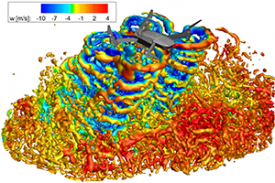
Courtesy: DLR Göttingen, Institute of Aerodynamics and Fluid Mechanics
Advanced Flow Insights Across Research and Industry
Automotive aerodynamics
Capture complete vehicle wakes, underbody flows, wheel aerodynamics, cooling flows, and aerodynamic structures for vehicle development and CFD validation.
Aerospace research
Investigate complex three-dimensional flows around wings, fuselages, propulsion systems, and high-lift configurations with comprehensive volumetric measurements.
Environmental and urban aerodynamics
Visualize wind flow around buildings, urban environments, and infrastructure to study wake development, pedestrian comfort, and natural ventilation.
Wind tunnel measurements
Ideal for industrial wind tunnel environments, Omni-PIV enables rapid installation, efficient testing, and high-fidelity measurements while maximizing the productivity of valuable wind tunnel time.
Marine hydrodynamics
Analyze the complex flow around ship hulls, propellers, hydrofoils, underwater vehicles, and renewable marine energy systems using comprehensive volumetric measurements in towing tanks.
Complete Fluid–Structure Interaction Insight
In addition to comprehensive flow characterization, Omni-PIV can be used as part of a complete fluid–structure interaction (FSI) measurement workflow. Flow and structural measurements can be evaluated within the DaVis software environment, enabling engineers to relate aerodynamic flow phenomena to the structural response of the test object.